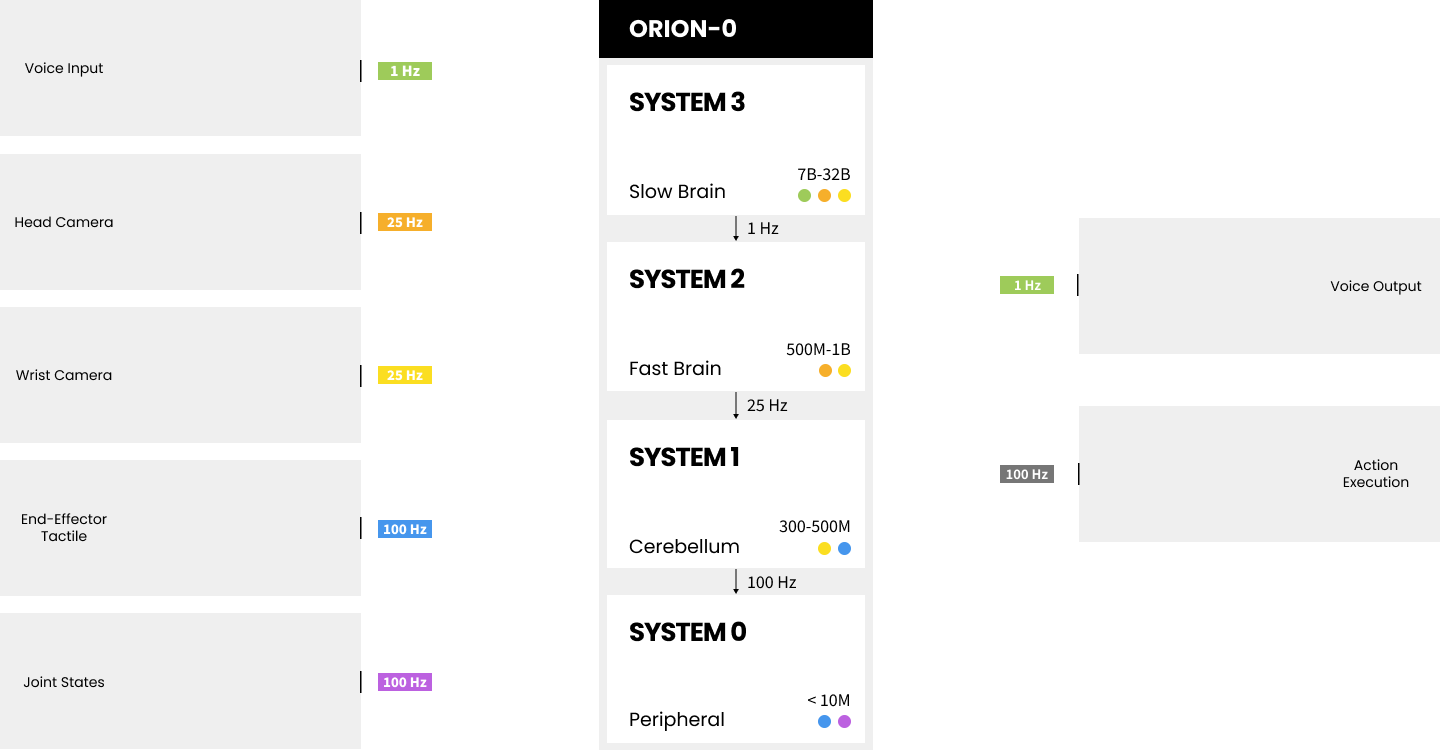
ORION’s layered design precisely separates intelligent decision-making from physical safety along both temporal sensitivity and functional hierarchy. S3 (Slow Brain) focuses on non-real-time deep reasoning and long-term memory. It enables complex semantic understanding and continuous knowledge accumulation. S2 (Fast Brain) handles real-time spatial perception, scene understanding, and action prediction, allowing rapid planning in dynamic environments. S1 (Cerebellum) is responsible for real-time perception and control execution, generating action commands that directly interact with the physical world. S0 (Peripheral Layer) serves as the safety-critical foundation, enforcing hardware-level constraints such as collision avoidance, torque limits, and emergency braking—ensuring safe execution regardless of higher-level decisions.
ORION adopts a highly flexible dual-track training paradigm to accommodate diverse application scenarios and cost constraints. Decoupled Optimization: S0 and S3 can be independently trained and iterated. S0 leverages classical robotics principles combined with lightweight perception models. S3 benefits from large-scale multimodal foundation models pretrained on internet-scale data. Embodied Core (S1+S2) Training Paths: Hierarchical Lightweight Training requires only small-scale datasets to quickly fine-tune deployable skills, significantly reducing data acquisition costs and deployment time. End-to-End Full-Scale Training uses large-scale, multi-source data for joint optimization, achieving stronger generalization in open and complex environments. Crucially, as S3 continues to evolve, it can distill knowledge into S1+S2, continuously expanding the action space—from limited real-world data to an effectively unbounded imagination-driven reasoning space—enabling the self-evolution of physical intelligence.